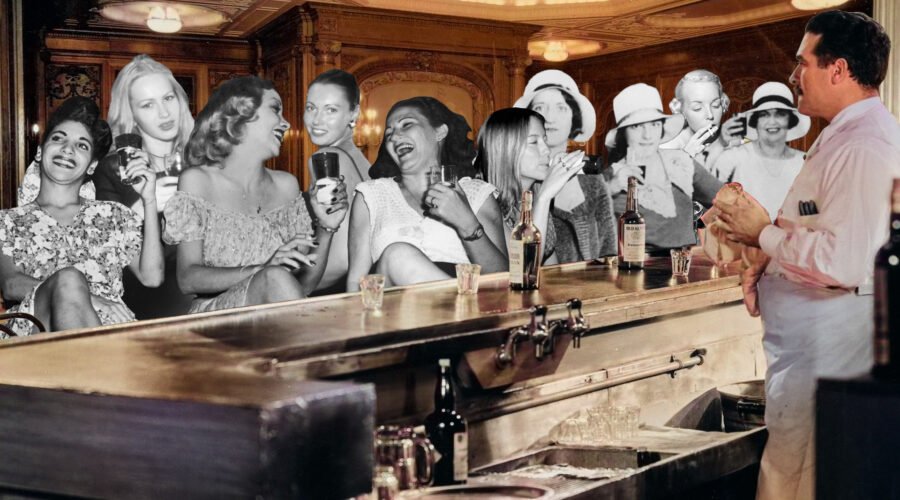
Prohibition Brought Women into the Bar—and Changed Everything
In pre-Prohibition America, respectable women didn’t belly up to bars. But after the 18th Amendment criminalized the production and sale of liquor, speakeasies brought about a different set of rules.
Behind the unmarked doors of those illicit establishments, women ordered cocktails sweetened to tame harsh bootleg spirits, smoked in public, danced to jazz, and mingled freely with men. The illegality of the setting blurred social boundaries.
The unintended consequence of Prohibition wasn’t widespread sobriety—it was social upheaval. The 18th amendment led to the collapse of the male-only saloon, ushered women into speakeasies, normalized mixed-gender drinking in public across economic groups, and nudged American courtship from chaperoned visits to modern dating. What gets lost in the romanticized stories of bathtub gin debauchery is the dawn of women’s political force.
“Women helped bring Prohibition to life, and they helped kill it too,” says Travis Spangenburg, the American Prohibition Museum’s creative manager. “It was really the beginning of the world we now live in, where women can better decide for themselves how they build their lives.”
Women’s Push for Prohibition
While Prohibition turned out to be a failure, alcohol had become a real public health issue by the early 20th century. The average American older than 15 drank at least seven gallons of alcohol a year. Barkeepers would cash men’s checks, and drunkenness exacerbated widespread domestic violence.
“These women saw themselves and their communities under the thumb of drunken husbands, abandoning their homes to spend time in the saloon and waste their money and their health away with little regard for their family’s future,” says Spangenburg.
Women like Frances Willard and Cary Nation led the Woman’s Christian Temperance Union (WCTU) in the 1870s, fighting hard to protect families from domestic abuse. As women’s political skills and organization grew under Willard’s leadership of the WCTU, the Temperance movement overlapped with efforts to champion women’s right to vote, labor reform, and public health services.
When the 18th Amendment passed on January 17, 1920, criminalizing the manufacture, sale, and transportation of alcohol, it was a match to the powderkeg of growing social change. Women were already crucial to the factory workforce, especially when men left to fight in World War I. Seven months after Prohibition started, Congress approved women’s right to vote.
Growing independence collided with the booze crackdown, and in the illicit world of speakeasies racial and gender integration made strides, as well as more acceptance of LGBTQ+ communities.
The Mob Museum’s director of education, Claire White, captured the time’s mindset: “If you’re going to break literal laws, then why are you that concerned about breaking social taboos? ‘Everybody’s doing it.’”
What Happens in the Speakeasy Doesn’t Stay in the Speakeasy
In Prohibition’s dimly lit corners, women were expressing themselves in new ways. Restrictive corsets and high piles of lady-like hair were replaced with chopped locks and boxy, androgynous flapper silhouettes. Structured waltzes fell out of fashion in favor of the free-swinging rhythm of the Charleston and the Shimmy. “Women cultivate relationships—platonic, romantic, and sexual—and start joining in on the party that men always had access to,” says Spangenburg.
But there was more than just a good time for women in speakeasies. They worked as servers, cigarette girls, singers, dancers, and bartenders. Some owned successful clubs, like the audacious actress Texas Guinan who greeted guests with a boisterous, “Hello, sucker!”
In these rooms talented jazz singers Ma Rainey, Bessie Smith, Josephine Baker, and actress Mae West became superstars with unprecedented power to call their own shots, like Baker declining segregated venues or Smith insisting she only travel in a private train car.
Women also helped cocktail culture flourish. Until the 1920s, Americans primarily consumed straight alcohol. But at the start of the century, women with disposable income demanded fruit juices, syrups, and sodas to mask the harshness. “Women are going up to the bar and saying, ‘I’m not drinking moonshine or bathtub gin unless you’ve doctored it up,’” explains White. At risk of alienating paying customers, bartenders mixed it up and soon were competing against each other for the buzziest new cocktails like the Sidecar, the Bee’s Knees, and the Gin Rickey.
Obviously, Prohibition was a flop. Organized corruption and violent crime rose, as many of the women who championed the movement were disillusioned with the reality of its enforcement and the rise of degeneracy. New York socialite Pauline Sabin, for example, changed course and founded the Women’s Organization for National Prohibition Reform, one of the largest Pro-Repeal organizations of the era. Yet even after the 21st Amendment legalized alcohol again in 1933, women had achieved lasting changes in politics, the workforce, American culture, and freedom at the bar.
White sees all the silver linings. As she puts it, “There are very few things that could have been more beneficial for women, in the long run, than Prohibition.”
More History Coverage

In the Shop
Personalized Amsterdam Whiskey Glasses (Set of 2)
In Stock | $49.95
Published: March 13, 2026