Native American Vintners Are Weaving Indigenous Tradition Into Modern Winemaking
Native Hands, a line of Cabernet, Pinot Noir, Chardonnay, and Grenache with labels that nod to rich Native traditions, is technically three years old, a baby in wine brand years. But its story really began three-odd centuries ago.
In 1779, Mission Indians planted the very first grape vines in California. In 1782, under the supervision of Mission San Juan Capistrano’s Father Mugartegui, the tribe made the state’s first wine.
These are Native Hands’ founder Chris Lobo’s people. His ancestors go back nine generations in the Juaneño Band of Mission Indians. He’s using his wines to tell the story of the first (real) winemakers of Alta California.
The Native American wine scene is still small in the United States, accounting for just a handful of winemakers. But the producers that make up the movement are intent on telling their story, the story of the land, and the story of those who came before.
They’re doing so through land conservation and regeneration, along with mentorship programs for the next generation of Indigenous winemakers. Many are funnelling profits and learnings back to the community, creating economic and ecological sustainability for their families and tribes.
// Create the element
var script_69289158759a1 = document.createElement(“script”);
script_69289158759a1.innerHTML = `
window.googletag = window.googletag || {cmd: []};
googletag.cmd.push(function() {
var adType = “leaderboard”;
var mapping;
var lbmapping = googletag.sizeMapping()
.addSize([1024, 0], [[970, 250], [970, 90], [1, 1], [728, 90]])
.addSize([728, 0], [[728, 90], [1, 1]])
.addSize([320, 0], [[1, 1], [300, 50], [300, 100], [320, 50], [320, 100]])
.addSize([0, 0], [[1, 1], [320, 50]])
.build();; // Size mapping for leaderboard ads
var medrecmapping = googletag.sizeMapping()
.addSize([1024, 0], [[300, 600],[300, 250]])
.addSize([728, 0], [300, 250])
.addSize([320, 0], [[1, 1],[300, 250]])
.addSize([0, 0], [[1, 1], [300, 250]])
.build(); // Size mapping for med rectengle ads
if(‘/39808611/article_page/article_leaderboard_1’ == ‘/39808611/article_page/article_leaderboard_1’
|| ‘/39808611/article_page/article_leaderboard_1’ == ‘/39808611/article_page/article_leaderboard_2’
|| ‘/39808611/article_page/article_leaderboard_1’ == ‘/39808611/article_page/article_leaderboard_3’) {
mapping = googletag.sizeMapping()
.addSize([1920, 0], [[728, 90]]) // >= 1920px
.addSize([1440, 0], [[728, 90]]) // 1440px-1919px
.addSize([730, 0], [[300, 250]]) // 730px-1439px
.addSize([0, 0], [[320, 100], [320, 50], [300, 100], [300, 50], [300, 250]]) // Up to 729px
.build();
} else {
mapping = adType == ‘leaderboard’ ? lbmapping : medrecmapping;
}
googletag.defineSlot(‘/39808611/article_page/article_leaderboard_1’, [],
‘div-gpt-ad-69289158759a1’).addService(googletag.pubads()).defineSizeMapping(mapping);
googletag.pubads().enableSingleRequest();
googletag.pubads().collapseEmptyDivs();
googletag.display(‘div-gpt-ad-69289158759a1’);
});
`;
// Append the script to the body
document.body.appendChild(script_69289158759a1);
Looking Back to Get Ahead
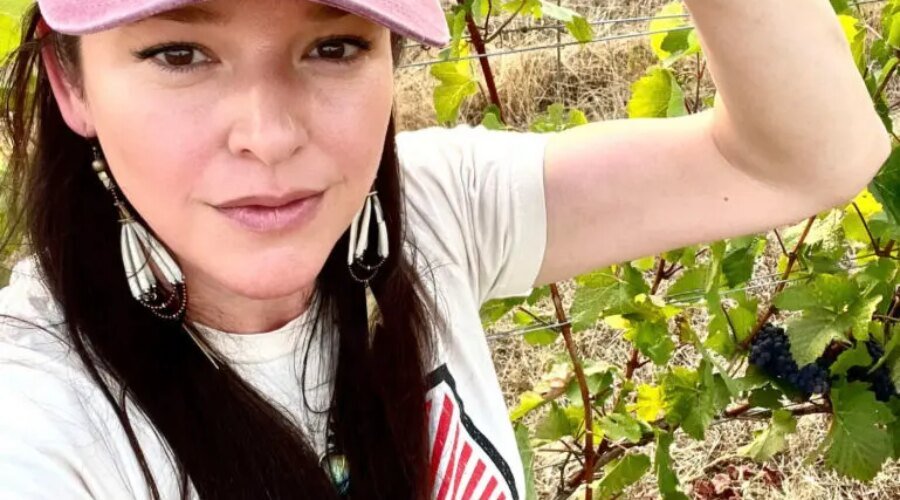
Brandy Grey (Cherokee/Shawnee) is a seasoned storyteller. She started her career as a journalist, first in New Mexico, where she was raised, then Oregon. About a decade ago, she made the move into wine, taking over as the tasting room manager at Fairsing Vineyard in the Willamette Valley.
As Grey’s wine career progressed—she now runs Greywing Cellars as a side project with her husband from a studio on Fairsing’s property—the more the former reporter realized the region wasn’t telling its full story to the best of its ability.
While Oregon’s wine industry was doing its best to promote the diversity of the people who have made it a success, Grey realized an important part of the conversation had been overlooked. “It struck me that we aren’t telling the full story of the land and how rarely this history is discussed in our industry despite being foundational to our landscapes,” she says.
Grey took it upon herself to dive deep. She poured through maps, books, and tribal resources to understand who inhabited the Willamette Valley in the centuries before it became an official American Viticultural Area (AVA). It was delicate work. Native communities are not monolithic, nor is everyone open to engaging in the wine industry in the same manner.
“We arrived here after generations of colonization and there are no quick and easy solutions on how to address that,” says Grey.
To make her research easier to digest, Grey began making maps to showcase the traditional names of the region’s geography. “Land acknowledgments can feel performative or undesirable by some Native communities, but I think a visual representation invites conversation,” says Grey.
Similarly, Lobo, a 38-year hospitality veteran and former Ritz-Carlton beverage director of operations, is using Native Hands as a way to expand the conversation on Indigenous influence in the wine industry and educate people about his cultural heritage. “There’s way more history to this than I ever imagined,” he says.
It’s been going well. His wines are served at pedigreed places like Drew Deckman’s restaurants in San Diego and soon the Ritz-Carlton, Laguna Niguel.
More significantly, his wines are poured at places where his community assembles to celebrate, such as the Indigenous Fashion Collective Gala in Los Angeles and Mission Indian Pow Wows.
At these events and others, he’ll say people are excited by the “story,” but he’ll catch himself. The word “story” suggests that there’s a marketing angle or narrative they pulled together to sell bottles. “It’s my family’s history,” says Lobo. “My tribe’s history. There’s something really powerful about being able to reclaim that.”

Stewarding Lands One Way or Another
Whereas Lobo wanted to take back his people’s winemaking tradition, the Yocha Dehe Wintun Nation, owners of Séka Hill Wines in the Capay Valley, near Sacramento, didn’t really intend to make wine. They’re farmers, land stewards. They have a dozen different crops, 800-or-so heads of Angus cattle, and are working on Wagyu crosses.
“When I started with the tribe in 2003, they owned about 1,000 acres of land,” says Jim Etters, director of land management. “The reservation was about 240 acres.”
They started small—wheat, sunflowers, and alfalfa, until they started planting grape vines and olives. Initially, their eight acres of grapes were sold off to other producers. Then, in 2012, the tribe realized the quality of their Sauvignon Blanc, Tanant, and Syrah was good, and processing the grapes (and olives) would be far more profitable than selling them off, creating a strong economic future for generations to come.
Native cultural perspectives on stewardship, reciprocity, and community are needed and wanted in wine.
Brandy Grey, GReywing Cellars
They were right. Their wine and olive oil business has been a huge success, allowing them to scale up and purchase more land. “Today, we farm and ranch right around 25,000 acres,” says Etters. “The reservation lands have expanded to almost 1,000 acres.”
But this is not your average agricultural expansion. The Yocha Dehe Wintun Nation is carefully tending the land. Native hedgerow plantings, pollinator habitats, erosion control, invasive species removal, rangeland improvements, and reduced pesticide use are part of their protocols.
They’ve also added a tasting room to their 14,000-foot olive mill, a place to not just indoctrinate new drinkers but educate guests on the area’s rich Native American heritage. “We wanted to give people an opportunity to sample all the tribes’ products, hear our story, the connection to the land, and the history,” says Etters.
People drive from all over the Bay Area to visit. “But, I would say, the majority of customers didn’t even realize there was a tribe here for thousands of years,” says Etters. “Not many wineries can tell that story.”

Though stories like Séka Hill’s aren’t common, the Yocha Dehe Wintun Nation isn’t the only tribe growing grapes on lands their ancestors have tended to for time immemorial.
Last year, winemaker Rob Campbell purchased a parcel of land in Sebastopol for his Sierra Nevada-based brand Meyye Wines. The upcoming Sonoma County vineyard is a big departure from Amador County, 150 or so miles away, where he’s currently based. But the move to Sebastopol is deeply personal for Campbell. His Coast Miwok grandparents married there in 1924, and for the last millennia, his ancestors called the area’s rolling hills home.
He describes the move as land repossession after centuries of land dispossession. “Ka ‘ooni yommitto,” he says. “I’ve come home.”
Meanwhile in British Columbia’s Okanagan Valley, Justin Hall, winemaker at Nk’Mip Cellars, the first Indigenous-owned winery in North America, is stewarding a small slice of the lands his band once possessed. European settlers, with the help of the Canadian government, pushed Osoyoos Indian Band band from the lush, fertile lands of the floor of Okanagan Valley to a tiny patch in the Southeast corner of the region—a fragment of the land they once called home and the only desert land in the entire country.
Turns out, the region is an excellent place to grow wine grapes. As the winery has grown, it has allowed the band to regain financial independence. Hall frequently taps his band members for agricultural advice—how to navigate frosts, fires, and other elements—who have a millennia of heritage on the land.

Other Native winemakers don’t have access to their ancestral land, but are finding other ways to incorporate their cultural heritage into the vinification process.
Chumash Winemaker Tara Gomez, who runs Camins 2 Dreams with her wife, Mireia, on California’s Central Coast, honors the reverence for the land that was instilled in her since childhood through sourcing organic, biodynamic, and regeneratively-farmed grapes from sustainably-minded growers.
Her Grüner Veltliner, Mencia, Albariño, and other lesser-known varietal wines are made with natural yeasts and minimal intervention, in tune with the surrounding environment. “I was raised on balance,” says Gomez. “Balance within myself, and my surroundings. Connectedness to the land, to the grapes, to the vineyards I work with.”
Building a Legacy
Gomez is committed to supporting the next generation of diverse beverage professionals.
Camins 2 Dream’s Kalawashaq label directs funds towards native and LGBTQ organizations. Gomez mentors up-and-coming talent through programs like Speed Rack, the Hue Society, and the James Beard Foundation. “It’s a difficult industry to be in, and a lot of the BIPOC community have reached out,” says Gomez.
Whenever someone does, she answers questions, guides them in the right direction, and opens the door, through those aforementioned programs, for those to follow behind her.
// Create the element
var script_692891587870d = document.createElement(“script”);
script_692891587870d.innerHTML = `
window.googletag = window.googletag || {cmd: []};
googletag.cmd.push(function() {
var adType = “leaderboard”;
var mapping;
var lbmapping = googletag.sizeMapping()
.addSize([1024, 0], [[970, 250], [970, 90], [1, 1], [728, 90]])
.addSize([728, 0], [[728, 90], [1, 1]])
.addSize([320, 0], [[1, 1], [300, 50], [300, 100], [320, 50], [320, 100]])
.addSize([0, 0], [[1, 1], [320, 50]])
.build();; // Size mapping for leaderboard ads
var medrecmapping = googletag.sizeMapping()
.addSize([1024, 0], [[300, 600],[300, 250]])
.addSize([728, 0], [300, 250])
.addSize([320, 0], [[1, 1],[300, 250]])
.addSize([0, 0], [[1, 1], [300, 250]])
.build(); // Size mapping for med rectengle ads
if(‘/39808611/article_page/article_leaderboard_2’ == ‘/39808611/article_page/article_leaderboard_1’
|| ‘/39808611/article_page/article_leaderboard_2’ == ‘/39808611/article_page/article_leaderboard_2’
|| ‘/39808611/article_page/article_leaderboard_2’ == ‘/39808611/article_page/article_leaderboard_3’) {
mapping = googletag.sizeMapping()
.addSize([1920, 0], [[728, 90]]) // >= 1920px
.addSize([1440, 0], [[728, 90]]) // 1440px-1919px
.addSize([730, 0], [[300, 250]]) // 730px-1439px
.addSize([0, 0], [[320, 100], [320, 50], [300, 100], [300, 50], [300, 250]]) // Up to 729px
.build();
} else {
mapping = adType == ‘leaderboard’ ? lbmapping : medrecmapping;
}
googletag.defineSlot(‘/39808611/article_page/article_leaderboard_2’, [],
‘div-gpt-ad-692891587870d’).addService(googletag.pubads()).defineSizeMapping(mapping);
googletag.pubads().enableSingleRequest();
googletag.pubads().collapseEmptyDivs();
googletag.display(‘div-gpt-ad-692891587870d’);
});
`;
// Append the script to the body
document.body.appendChild(script_692891587870d);
Séka Hills also offers advice. Tribal representatives from as far away from New York have reached out to ask what worked for their business and vineyards, what didn’t, what challenges they faced. “The Tribe has been very willing to share this information with other Indigenous peoples,” says Etters.
Grey donates a portion of sales from Greywing’s wines to Indigenous non-profits, like NAYA Family Center and Adopt-A-Native Elder—a rotating cast of programs that support a wide range of issues from food insecurity affecting Elders to the ongoing crisis of violence against Native women. It’s reciprocity, “a direct investment in the communities who shaped and protected the ecosystems we all benefit from today,” she says.
Like Lobo’s Native Hands, when Grey started her own label in 2016, the goal wasn’t solely to produce wine. “It was a way to share my family’s story as well as show youth that there is a place for Native people in every part of agriculture, hospitality, and land-based industries,” she says. “Native cultural perspectives on stewardship, reciprocity, and community are needed and wanted in wine.”
More Indigenous Wine Coverage
- Here’s another dive behind the rise of Native American wine.
- And we’ve rounded up nine of the most influential Indigenous wineries around the world.
- Plus, five drink pros shining a light of Native American culture.
- Want to know how and why Tara Gomez got into wine? A childhood chemistry set.

From the Shop
Find Your Wine a Home
Our selection of red wine glasses is the best way to enjoy the wine’s subtle aromas and bright flavors.
The post Native American Vintners Are Weaving Indigenous Tradition Into Modern Winemaking appeared first on Wine Enthusiast.