The Best Long Island Wineries to Visit Right Now
New York State is full of surprises. You know you’ve hit the rural bits of Long Island’s North Fork—and, therefore, wine country—when you see a giant inflatable strawberry jiggling in the wind, like the one outside Bayview Market & Farms in Riverhead. The hamlet of Flanders’s Big Duck, whose innards house a poultry store, serves as a similar landmark at the mouth of Long Island’s South Fork. They’re not official markers, of course, but there’s something delightful about a conspicuously oversized roadside attraction letting you know you’ve left the city far behind.
Comprising 1,400 square miles, Long Island is the nation’s largest and longest contiguous island. It consists, in large part, of sprawling suburbs and strip malls, but its East End, as it is known, is far more bucolic. Divided into the North Fork and South Fork by the Peconic Bay, this sliver of land birthed the region’s wine industry half a century ago.
Long Island celebrated a half century of winemaking in 2023. Fifty years may be a heartbeat in a global wine context, but it’s a profound milestone for a region like Long Island, which is, in many ways, just hitting its stride. Wine grape farming is improving. As some vines come of age, others are being dug up and replaced with more climate-suitable clones and varieties. Meanwhile, second-generation producers—alongside new, internationally experienced winemakers—are getting their hands dirty in Long Island’s sandy loam soils.
Combine that with a multitude of recently opened or renovated tasting room and food experiences, plus the ever-enticing beach-life vibes, and there’s no better time to acquaint—or reacquaint—yourself with New York’s second-largest wine-producing region.
As Wine Enthusiast’s reviewer of wines from New York State, I hold Long Island near and dear to my heart. Below you’ll find my picks of some of Long Island’s top wineries, along with recent releases bound to delight even more than inflatable fruit and giant poultry.
The North Fork
Stretching from Riverhead to Orient Point, the North Fork contains more than 60 vineyards spread across the nearly 30-mile-long stretch. The pastoral peninsula is dotted with farm stands and more than 100 active farms, which are a draw throughout the spring, summer, and fall harvest seasons.
Paumanok Vineyards
Aquebogue
One of Long Island’s westernmost wineries, Paumanok Vineyards is also one of its most longstanding. Founded in 1983 by Ursula and Charles Massoud, who emigrated from Germany and Lebanon, respectively, Paumanok is now run by sons Kareem and Salim. A true family business, Kareem is winemaker and Salim the operation’s administrative manager. Charles and Ursula are still very involved in the winery’s key decision-making.
Paumanok’s winery and tasting room are housed in a renovated, turn-of-the-century barn clad in weatherboards. The interior is airy and calm, while the large deck provides expansive views of the vineyards, which parade over one of the few hills on the notoriously flat island. Paumanok hosts a sunset special of raw oysters, a Greek snack bar, and $8 glasses every Friday in the summer. But it’s also worth snagging a seat at one of the Grand Vintage tasting dinners. Like other long-established Long Island producers, Paumanok is known for holding back stocks of their highly cellar-worthy Merlot and Bordeaux blends, but it also makes an excellent Chenin Blanc, “minimalist” Cab Franc, plus glug-worthy aromatic whites like Albariño under the Palmer label.
In 2018, the Massouds purchased nearby Palmer Vineyards, where they operate a second tasting room that’s reminiscent of a traditional English pub, with live music performances and dinners featuring wood-fired pizzas. The Massouds’ third son, Nabeel, runs Fiocha Pizza in Mattituck, also known for its stellar wood-fired pizza.

Macari
Mattituck
Like Paumanok, Macari is a family affair. The winery began in 1995 when Joseph Macari Jr. and his father first planted vines on the 500 acres of fallow land—formerly a potato farm—that Joseph Sr. had purchased in the 1960s. Today, Joseph Jr. and his wife Alexandra still helm the ship, but daughter Gabriella and son Joseph M. are also intimately involved, the former as Director of Operations and the latter as Head of Viticulture.
Macari has long been a leader on the viticulture front, employing organic and biodynamic techniques and omitting herbicides. In 2020, Macari brought in a new winemaker, Byron Elmendorf, who has taken its operation in an exciting direction, one that sees more wild ferments, lees aging and a general uptick in experimentation and creativity.
Despite having to navigate the notoriously strict regulations surrounding food service from both New York State and Southold township (where around 75% of the North Fork’s wineries are located), Macari offers a multitude of events that feature visiting chefs like Lauren Lombardi, whose beautifully prepared and ultra fresh seasonal dishes are worth the trip alone.
In 2022, Macari renovated and re-launched its tasting room in nearby Cutchogue as Meadowlark. With a beautifully designed wine bar, events space and a range of wines, Meadowlark seems set to become one of the North Fork’s top wine and wedding destinations.

Rose Hill Vineyards
Mattituck
Rose Hill is one of the new(ish) kids on the North Fork block, having been purchased by Randy and Barbara Frankel in 2017 and fully renovated and rebranded in 2021. But in its former guise as Shinn Estate, this Mattituck-based winery was one of the first to establish a connection with New York City’s restaurant scene. These days the wines are sold almost entirely from the tasting room, but it’s worth the in-person visit. Rose Hill boasts one of Long Island’s most beautifully designed wine spaces. Beside the classic weatherboard farmhouse that serves as a four bedroom inn (see “where to stay” below), there’s a welcoming vine-side patio, a shop selling local goods as well as wine, and a gorgeous boho-chic tasting room offering modern, delicate wines made by longtime winemaker Patrick Caserta (try the Brut Rosé to complete the classy feel). Pair them with filling “light bites” like warm pretzel batons, sliders with prosciutto, burrata, and arugula, and whipped ricotta and crostini.
Note: Rose Hill’s sister establishments—both as thoughtfully designed as Rose is—are also worth checking out. The focus of Croteaux in Southold is exclusively on rosé, served from a space that feels simultaneously classic Long Island and also like something out of the French Riviera, with lobster sliders and croque monsieur to pair. Meanwhile, Main + Mill in Jamesport is designed with 1920s Hollywood glamour in mind, with an expansive patio for summer sipping and a cozy tavern-style space indoors with a crackling fire to wile the winter blues away. The wines, while fairly classic in style (all made by Caserta), pair with vintage dishes like shrimp cocktail, pigs in a blanket, and tater tots. There’s even a Shirley Temple on the menu for the little ones, making this a family-friendly stop.

Lieb Cellars
Cutchogue
Perched less than a mile from the Long Island Sound, Lieb Cellars makes remarkably saline wines that speak of their maritime surroundings. This is thanks both to the careful farming of longtime vineyard foreman Ildo Vasquez, and to Lieb’s Aussie-born winemaker Russell Hearn. In 2023, Hearn co-purchased Lieb from its former owners and the cozy-yet-classy tasting room now pours wines from both Lieb and Hearn’s other label, Suhru Wines. Both can be enjoyed with live music, via a themed masterclass, or with freshly shucked local oysters on Friday oyster nights.

Bedell Cellars
Cutchogue
The tasting room at Bedell Cellars has a bright and airy modern appeal that pairs with its clean, textural, food-friendly wines. This is one of Long Island’s longest-standing wineries, dating back to 1980 (with a change in ownership in 2000). Long Island wine pioneer Richard Olsen-Harbich spearheaded Bedell’s winemaking for over 40 years before officially handing the reins over to Marin Brennan in 2024. Brennan has continued the winery’s spirit of creativity and penchant for saline-streaked aromatic whites. All fermentations are spontaneous, or kickstarted with self-foraged botanicals to capture the essence of Long Island terroir.
Corey Creek is Bedell’s second label, also made by Brennan, who launched the new range in 2021. At Corey Creek’s Tap Room, the vibe is more artisanal, with a chic beach hut feel and live music on the front porch overlooking the vineyards.

Lenz
Peconic
Wedged between Bedell and Corey Creek is Lenz, Long Island’s second-oldest winery. Founded in 1978, the winery has been owned by Peter and Deborah Carroll since 1988. In that time, Lenz has had just one vineyard manager, Sam McCullough, and two winemakers: Eric Fry, who retired after 30 years in 2018, and Thomas Spotteck, who was Fry’s assistant winemaker. Lenz is best known for holding back its reds for at least four to five years before release, and for its aromatic Alsatian varieties like Gewürztraminer and Pinot Gris.
The tasting room, housed in an old barn surrounded by some of the region’s oldest vines, is quintessential North Fork. There’s a range of pre-prepared food and non-wine drink options, including cheese and charcuterie, cold brew, and local beer. Events throughout the year include “Dinner in the Vines” and pop-ups like local dumplings and wine.
The South Fork
A 75-minute drive (or 90 minutes via car ferry, which is highly recommended) from Greenport on the North Fork, Long Island’s South Fork may be equally beautiful, but it’s otherwise an entirely different scene. This part of Long Island is home to the Hamptons, the famed coastal playground for New York’s wealthiest inhabitants. There are just three wineries here, each with its own vibe.
Wölffer
Sagaponack
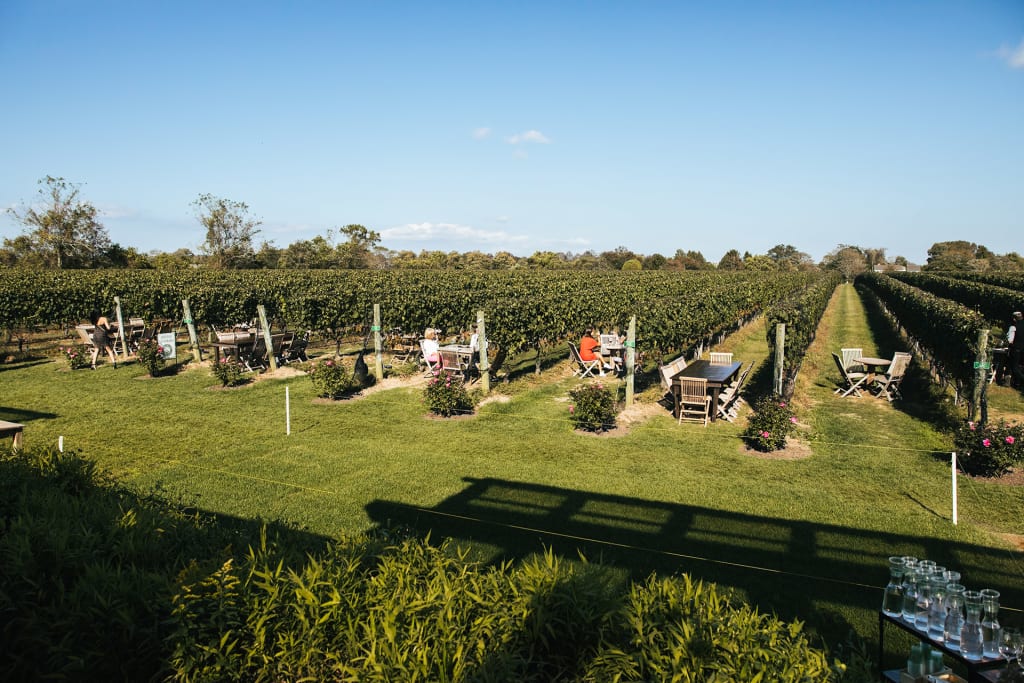
Perhaps nowhere embodies the Hamptons more than Wölffer Estate, one of Long Island’s busiest, buzziest tasting rooms. High-end SUVs regularly drop gaggles of young, well-groomed guests outside the steps of the Provençal chateau-inspired estate, where they sip dry rosé beside sweeping vineyard vistas.
Wölffer’s Summer in a Bottle rosé, which helped popularize the dry, southern French style now ubiquitous in America—and of which the winery makes a staggering 125,000 cases a year—now comes in two cuvées, one made on Long Island and the other in the Côtes de Provence. (There’s also now a Summer in a Bottle Sauvignon Blanc and a non-alcoholic range, Spring in a Bottle).
But look beyond the aspirational lifestyle branding and what you’ll find is a vast range of high-quality wines that range from $16 to $125 a bottle. The ability to juggle all ends of the quality spectrum is a tribute to Wölffer’s gregarious German-born winemaker, Roman Roth, who has clocked 34 vintages at the company and is a business partner.
Roth also has a private label, Grapes of Roth. Both labels can be tasted with small plate snacks at the tasting room or at Wölffer’s Wine Stand, just around the corner from the estate, on Montauk Highway.

Channing Daughters
Bridgehampton
Despite being less than a 10-minute drive from Wölffer, the understated and idiosyncratic Channing Daughters couldn’t be any more different. Here the focus is not on the small tasting room—charming though it may be—or on the simple outdoor set up of vine-side picnic tables and tents. The wines themselves are the main attraction. They are among the most colorful on Long Island. James Christopher Tracy, who has been the winemaker since the early 2000s and is now a business partner, is restlessly creative, crafting a dizzying range (over two dozen separate bottlings) of minimal-intervention, textural wines from a huge array of grape varieties, including some not seen anywhere else in New York. There’s a waxy, melon-y Tocai Fruilano, an array of aromatic field blends, and a golden, oxidative Ribolla Gialla, to name just a few. While some are more successful than others, each wine is distinctly different, expressing varietal, place and the winemaker’s intention.
More Wine Travel Coverage
The Ultimate Suitcase for Wine Country
Our Vino-Voyage TSA-Approved 12-Bottle Wine Suitcase makes the perfect companion for every winery on your bucket list.
FAQ
Are Long Island Wineries Open Year-Round?
Yes, although some tasting rooms limit hours during winter months. In the summer, some wineries close for weddings and other events. While a few still require reservations, most accept walk-ins. It’s always best to check a winery’s website or social media pages if you have your heart set on visiting. If you prefer to wing it, North Fork wineries in particular are close enough together that if one is shut, you’ll likely find another open nearby.
How Many Wineries Are on Long Island?
Long Island is home to around 60 wineries across over 3,000 acres of vineyards.
What Wine is Long Island Known For?
Traditionally, Merlot, Bordeaux blends (known in the U.S. as “Meritage”) and Chardonnay, along with dry rosé. But these days, Long Island’s varietal palate is broad.
The moderate-to-cool maritime climate makes low-alcohol wines that are naturally high in acidity with a distinctive saline thread. There are excellent examples of Alsatian and German whites like Pinot Blanc, Pinot Gris, and Gewurztraminer, with some Sauvignon Blanc (the most interesting spend time in old oak and on lees) and Albariño, the current “it” variety. For reds, Cabernet Franc is particularly exciting and ripens more consistently than northern New York regions. Northern Italian grapes like Teroldego and Lagrein also find a happy home on the East End.
What Is the Largest Winery on Long Island?
Pindar claims Long Island’s largest production, with 70,000 cases, of wines made in Long Island, but if Wölffer’s Summer in a Bottle Côtes de Provence label is included in the tally, it puts the South Fork winery in the lead.
Which Part of Long Island Has the Most Vineyards?
Most producers are located in the North Fork, between the towns of Riverhead and Greenport. There are just three wineries on the South Fork.
Published: April 24, 2026