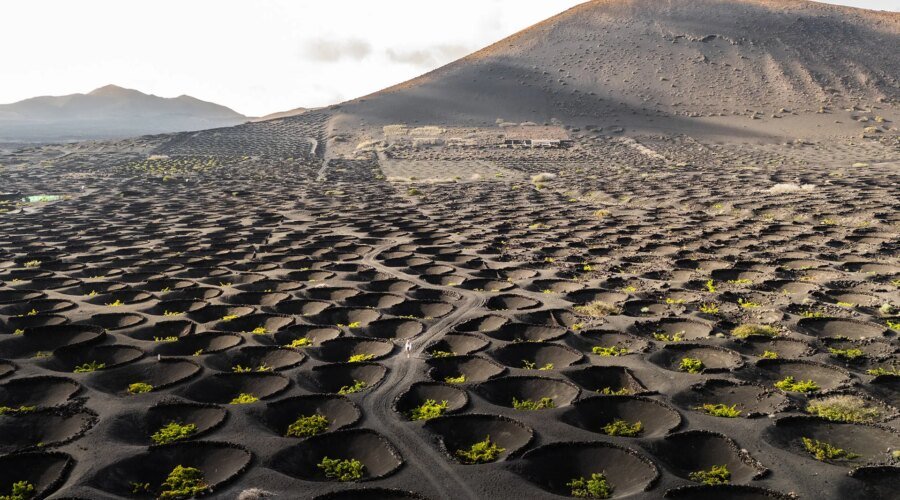
The Canary Islands’ Volcanic Wines Deserve a Bigger Audience
Despite a “perpetual spring” of sunny days and mild temperatures that attract northern Europeans on beach vacations, the Canary Islands have long been one of Spain’s poorest regions. Remoteness and volcanic terrain make life on the Atlantic archipelago beautiful, but often difficult.
For centuries, families farmed small plots of potatoes, grains for gofio (a local toasted flour dish), and grapes for wine. On Lanzarote, the easternmost of the seven main islands, a family might maintain 250 to 400 individual vines in volcanic craters, with all labor performed by hand. Mechanization proved impossible, even if residents could afford it.
Now those same labor-intensive viticulture methods breathe new life as a form of artisanal authenticity. Canary wines retail locally for €12 to 18 per bottle (or around $14 to 21 USD)—similar to quality wines from mainland Spain, but produced under dramatically tougher conditions. This relatively upscale market position aligns with the Slow Wine movement, which prizes traditional methods and bottles that reflect their origins, validating the techniques that poverty preserved. However, Canary winemakers themselves acknowledge an uncomfortable truth: At current prices, with hand-harvesting and climate volatility, the economics barely pencil out.
Scale is not possible, but therein lies the opportunity for small producers: offering locals and visitors a viticultural experience unavailable anywhere else in the world.
What Makes Canary Wines Unique
The Canarian people are known for their resilience, having subsisted for centuries on islands battered by winds, seawater, and, frequently, foreign influence. That their pre-phylloxera vines have thrived off the coast of Africa is a testament to that spirit of toughness, which goes back centuries.
“It was born from the volcanic eruptions of 1730 to 1736,” says Esperanza Sáez, communications manager at Bodegas Vega de Yuco on Lanzarote. “People had to find that fertile land beneath the volcanic ash to plant not only vineyards, but fruit trees, vegetables—to survive, to eat, to get through the famine and not have to emigrate like many did.”
Nearly 300 years later, those survival techniques have become the foundation for something marketable. As Juan Cruz Ruiz writes in The Canary Islands: A Cultural History, “In a time when people praise slowness as a last resort against the hustle and bustle of contemporary life, the slowness of the Canary Islands should be a medicine or antidote.”
Lanzarote’s harvest is among the earliest in Europe, typically occurring in July when mainland Spanish regions are still months away. Production aside, the volcanic soil produces wines with distinct minerality and character. Indigenous grape varietals rarely found elsewhere—including Listán Negro, Malvasía, and Diego—thrive in the picón volcanic ash that acts as natural mulch, retaining what little moisture the islands receive.
“You’re tasting a unique product—singular, sustainable, unique in the world,” Sáez says. The vines are planted on their own roots rather than grafted rootstock, a rarity in modern viticulture made possible by the volcanic islands’ isolation from and resistance to phylloxera (though the grape blight was detected on Tenerife for the first time in July 2025).
Reggie Solomon, Wine Enthusiast’s reviewer for the region, sees positioning potential. “If I were going to talk about the Canary Islands, it’d be in that context, comparing it to other volcanic wine regions” like Sicily‘s Mount Etna or Greece‘s Santorini.

Growth Meets Volatility
Lanzarote alone grew from 16 wineries in 2015 to 42 in 2025, while Gran Canaria now counts 41 active wineries. Each island offers different microclimates and varietals. But climate change has made production wildly unpredictable. Lanzarote produced 2.8 million liters in 2018, then just 967,654 liters in 2024—a 66% decrease in six years. Gran Canaria’s output fell from 289,433 liters in 2022 to only 116,104 liters in 2024.
The result? Wines selling out before the next harvest. “We had no surplus, we had no wine, we exhausted all stock, and had to sell by quota,” Sáez says. Bodegas Vega de Yuco, which buys from more than 250 small growers, couldn’t meet demand. “Our clients had a determined quota to buy because we didn’t have enough to reach everyone, and we ran out of wine.”
Agustín Cabrera, who owns Señorío de Cabrera, a hillside family winery in Gran Canaria, explains the impact of these conditions. “We don’t have seasons here on the island—the four seasons are practically combined into one,” he says. “We don’t have winter; summer is always very strong. And the vines need those seasons to have cold in winter and then heat in summer.”
The scarcity reveals something about scale, too. Nearly half of Gran Canaria’s 589 registered vineyard parcels measure less than 1,000 square meters—family subsistence plots that happen to produce wine, not commercial vineyards designed for volume.

The Pricing Problem
The labor reality explains why scaling up remains out of reach. “Most of the viticulture is worked by families and growers of a certain age,” Sáez says. Workers in their seventies and eighties climb into volcanic craters for harvest, pruning, and leaf cleaning. “They have to get into a hole and bend down for the harvest or maintenance, and then the reconstruction of the stone walls, which is also done by hand”—rebuilt stone by stone without cement, protecting vines from Lanzarote’s relentless winds. The vines are planted on their own roots, not grafted at height, making every task more physically demanding.
Cabrera’s family operation—himself, his wife, their grandson, and a dog—harvests together, picking 1,000 to 2,000 kilograms in a day when conditions allow.
Solomon applies an industry lens to this romance. “Everyone is on the same playing field once the wine hits the glass,” he says. “The amount of effort you put into it needs to show.” His pricing assessment is blunt: “At €12 to 18 per bottle, I don’t see that labor fully accounted for.”
Cabrera agrees. “The prices are not sustainable,” he says. “Our winery is sustained because we look at it as more of a hobby. If we look at the vineyard’s economic performance alone, we would close the winery.”
So why continue? “I love making wine. I love having my small estate,” Cabrera says. “I love making my wines and having our clients value our effort. If we were to calculate our work and charge for it, we should close the winery. But it’s truly compensated by the people who visit us and the gratitude they give us for the good wines we have on the island.”
However, Solomon believes that to be successful, a wine region needs to export at least 25% of its production. “If you want the world’s attention, you need to provide the world the wine,” he says. “I don’t see them exporting enough that it makes sense for me to have an elevator pitch about island wines of Spain.”
Indeed, Canary wines remain hyper-local. “Our market is mainly Canarian,” says Sáez. “We see exports from the point of view of serving the customer who has already come to the Canaries, who already knows the wine.” They’re selling to tourists after they return home, rather than building foreign distribution networks.
Cabrera’s approach is even more local: they aim to sell all their wines at the winery. “We used to have five restaurants on the island where we sold our wines, but because of production decreases, we prefer to sell it at the winery to our clients who come visit us.”
To the outside world, this creates what Solomon calls a pricing trap. “You’ll never increase your prices because your locals won’t pay for it,” he says. “But your foreign markets will.” He draws parallels to Bergerac, France, where “tourism is actually a bigger economic boon than the wine industry. I do see parallels from the Canaries, where tourism is both a help, but can also be a potential threat.”

The Future of Canary Wines
Canary Islands wines exist in a space between profit and passion—sustained by tourism, tradition, and what Cabrera calls “gratitude that doesn’t give us money.” Yet the Slow Wine movement has created demand for exactly what the Canaries offer: volcanic terroir, indigenous varietals, and wines that reflect heritage, rather than industrial efficiency.
Solomon positions these wines with a parallel for consumers willing to explore. “If you like Portugal and all the indigenous varietals Portugal has, you’ll love the Canary Islands,” he says.
Some producers are testing export waters. Bodegas Vega de Yuco recently participated in a trade mission to Texas, exploring the U.S. market as a specialty product. “We’re not pretending to have big exports,” Sáez says, “but we want presence in the North American market.”
The challenge isn’t whether these wines are worth seeking out—Sáez’s sold-out vintages answer that question. It’s whether enough consumers will turn over stones to try something mostly available in a faraway land.
The volcanic soil that made life difficult for centuries, may yet prove to be these islands’ greatest asset. That is, if winemakers can translate hardship into value that consumers recognize not just with gratitude, but with dollars that sustain that work. For now, that’s happening one visitor, one winery, one sold-out vintage at a time.
More Spanish Wine Coverage

In the Shop
Flex Your Collection
Transform your home into a wine lover’s paradise with a custom wine cellar. From design to functionality, Wine Enthusiast can create the perfect storage solution.
Published: January 5, 2026